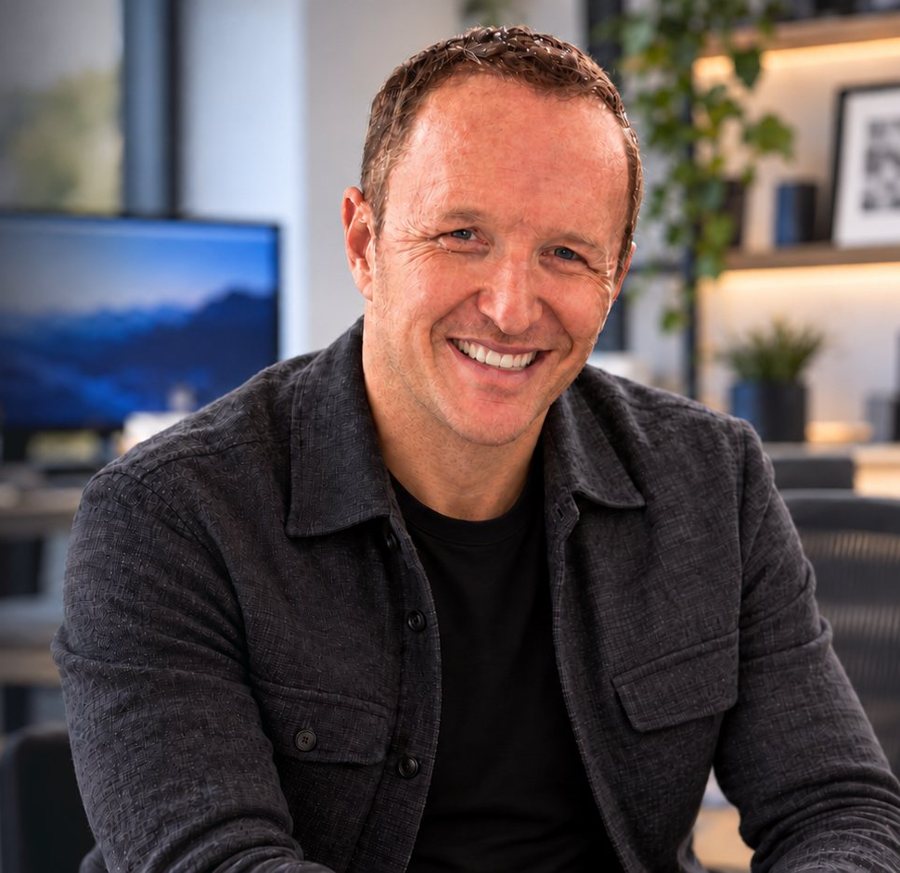
I know the selection rules because I wrote them. By those rules, I would not have chosen myself.
I am here for another reason. Not as proof of greatness. As evidence of inheritance.
I grew up on the northeast side of Cedar Rapids and attended Wright Elementary, Harding Middle School, and Kennedy High School. I did not know then that I was living inside a city built by the people in these chapters. I knew their companies, buildings, neighborhoods, and institutions mostly as parts of the landscape. Children rarely recognize inheritance while they are receiving it. Teenagers are often blind to their blessings, and young adults are often just as blind and equally dismissive, seeking something different, something more grand, something that's theirs. I was. It took time and maturity for me to appreciate how special Cedar Rapids is and the gifts it gave me.
What I did recognize early was the need to make something. At sixteen, I discovered eBay while it was still new enough to feel like a secret door in the wall. Drummers who wanted to build their own drum sets needed custom shells, and I believed I could sell them. I called the business VA Drum Company—Verra Amor, "true love"—because even then I believed an enterprise deserved a little romance. Much like the prose of this book, that overly romanticized pulse still beats into my work.
My mother gave up her garage during the Iowa winter so I could store inventory. That detail matters more to me now than it did when I was sixteen. Entrepreneurship is often narrated as the founder's courage, but the first capital frequently arrives at someone else's inconvenience. Entrepreneurs get celebrated for their sacrifice while those who sacrifice most stay silent in the corner, not wanting the accolades or the thanks. The truth is known within them, and that's enough. (Thanks, Mom.)
She gave me space before the business had proved it deserved any. The company was small. It did not change Cedar Rapids. It changed me. A stranger from across the world could want something that did not exist in his town, find a teenager in Iowa through a computer, trust him with money, and receive a product built around that request. The distance between an idea and a customer had suddenly become shorter than the adults around me seemed to understand. I was hooked.
The Decision That Made No Sense on Paper
I later attended Cornell College in Mount Vernon, studying political science and economics on a full scholarship. During my senior year, with roughly seven months left before graduation and a 3.0 grade-point average, I left school to become owner and managing partner of 3rd Street LIVE, a seven-hundred-seat concert venue in Cedar Rapids's NewBo district.
Leaving a full scholarship seven months before graduation was not the efficient decision. It was not the safe decision. Depending on the day and the outcome being measured, it may not have been the intelligent decision. Ok, it was stupid. (Sorry, Mom.)
It was the decision I made because business ownership had become more compelling than preparation for business ownership. I wanted the consequence before I had completed the credential. A calling is a calling, and it's hard to turn down.
3rd Street LIVE placed me inside a business where every event concentrated risk into one night. Talent had to be booked, promoted, staffed, secured, staged, lit, amplified, ticketed, and delivered before the audience decided whether the room had been worth entering. Empty seats could not be stored and sold the following week. A bad night expired immediately. The business taught me that a product can vanish while it is being delivered.
Then the 2008 flood made the lesson physical. The venue was damaged beyond reopening. The business I had left college to own and operate disappeared inside the same catastrophe that opens this book.
I did not rebuild 3rd Street LIVE. Frankly, the partnership had disintegrated before the flood dealt the final death blow. I am not a victim of the 2008 flood like so many others; the flood simply made reality real. In the coming months I left Cedar Rapids and moved to Charleston, South Carolina.
That fact complicates the story I have spent this book investigating. Rebuilding does not always mean preserving the same company, the same building, or even the same address. Sometimes the useful thing that survives is the person who now knows how quickly a future can disappear.
I carried the instinct somewhere else. Since arriving in Charleston, I have built ventures in software, agency tools, social media for business, live video software that was purchased by NFL teams, vacation rentals, medical transportation, and more. Some big wins. Some painful losses. But life is not like baseball—there are a lot more opportunities than three strikes, and I'm living proof of that wisdom. Honestly, one home run is all you really need. Strikeouts be damned.
The business names changed. The instinct did not.
I still live in the Charleston area with my beautiful wife Shauna—an entrepreneur in her own right—and two daughters whom I adore beyond words. My professional work now centers on AI models and tools for businesses, inside a technological moment that feels like the early internet again: unstable, overhyped, open, and full of unclaimed ground. It is day one again, and I welcome it. Frankly, I feel like the 24-year-old moving to Charleston with nothing more than what I could fit in my car. Eyes bright and facing forward.
For years, I assumed that was simply my personality. This book made me question whether it was entirely mine.
The Project That Was Not Supposed to Become a Book
I never wanted to write a book. I wanted to learn how to build and direct AI agents.
The original project was a technical exercise using Hermes, a multi-agent platform. I wanted to know whether I could design a system in which specialized agents performed research, source handling, outlining, writing, editing, and quality control while I remained primarily the director. Nothing more.
I gave myself an extreme constraint: produce a serious book without personally writing it. Fourteen AI agents that I designed and directed ran through the initial research and development process over roughly twenty-four hours. Different large language models were assigned according to the task. One agent searched for entrepreneurs. Another gathered evidence. Others organized sources, challenged claims, drafted chapters, evaluated narrative structure, and tested the manuscript against rules I had established.
The result was remarkable. It was also not good enough.
The system produced a book-shaped object with real research, recognizable chapters, a coherent chronology, and moments of strong writing. It proved that the machinery worked. It did not prove that the book deserved to exist. I sent the agents through additional passes. The prose improved. The evidence deepened. Gaps closed. The manuscript became more professional, more complete, and more convincing.
It was still not alive. Then I made the mistake that changed the project.
I fell in love with the subject. The stories stopped being outputs in an experiment. Nicholas Brown's dam, George Greene's institutions, Arthur Collins's company, Milo Barta's counterpower, Cecil and Evelyn Reed's rooms, Gail Naughton's museum, Willie Ray's food, and Sydney Rieckhoff's first counter became obligations.
Once the stories mattered to me, efficiency stopped being the only measure of the system. The book had to become worthy of them.
The Notch Where the Book Lived
I learned something about artificial intelligence that surprised me. It could write. The most fulfilling surprise was that this book acted as a medium for me—a medium that allowed me to remember that I could write. Not emails, code, or marketing jargon, but poetry and truth.
AI could write cleanly, quickly, and often beautifully. It could identify structure, explain a business model, connect evidence across decades, imitate tone, revise weak passages, and produce sentences I would have been proud to write from a blank page.
It could also remain wrong by exactly one notch. That notch mattered—a lot. The facts were often present. The meaning was not. AI could get within one notch of human judgment, and the book lived inside that notch.
That was where I entered most fully. Not as the person performing every search, typing every first sentence, or building every technical component, but as the person deciding what the work meant and refusing to let a nearly correct answer survive because it sounded polished.
Atlas became my principal collaborator. We went chapter by chapter through the entire manuscript, arguing over emphasis, cutting generic language, identifying the astonishing fact, rebuilding transitions, deepening moral tension, and forcing every chapter to answer the larger investigation. Sometimes I supplied the line. Sometimes Atlas did. Often one of us produced the thought and the other found the sentence. The final language became difficult to separate cleanly, because collaboration works by altering both participants' next decision.
I wrote far more of it than I expected, and that was both therapeutic and clarifying—it allowed me to remember who I am. If this book reaches no one and has no readers, frankly, I don't care. It could end up as a mandala in a wastebasket. I created it for the sake of creation, and what I created was worthy of existence.
I began the project hoping to prove that I could direct a book without writing it. I ended it no longer certain where directing stopped and writing began.
The Tractor Analogy Is Not Enough—The Question of Our Day
Is a farmer less of a farmer because he uses a tractor instead of a horse and plow? Is a painter less of a painter because she uses a sprayer instead of a brush?
The obvious answer is no. Builders have always used machines to extend force, speed, precision, and reach. Refusing the best available tool is not integrity when the refusal serves no purpose beyond protecting an older image of work. I would argue that artificial intelligence belongs inside that history.
But the tractor analogy only gets us halfway. A tractor amplifies muscle. AI amplifies language, pattern recognition, imitation, analysis, and decision. A tractor does not propose a chapter structure, imitate the farmer's voice, summarize the field, or claim credit for the harvest. AI can produce work that looks complete enough to conceal how little the person presenting it actually contributed.
That makes disclosure part of the craft. AI does not cheapen work merely by participating in it. Concealment cheapens the work. A person can use AI to produce something beyond his unaided ability and still act honestly. The dishonesty begins when the tool's contribution is hidden so the audience will assign skill, labor, or originality to the wrong source. I refuse to follow that path.
So here is the full disclosure. I used artificial intelligence heavily in this book. AI agents performed nearly all of the first-pass research. They assembled timelines, located records, compared accounts, generated source notes, and identified gaps. AI drafted most of the manuscript's original prose and much of its final prose. A Claude coding agent built the first version of the website on which this work was published. Hermes coordinated the initial multi-agent system.
And here is what the machines did not do. I selected the question. I designed the system. I directed the film, even if I didn't write every scene. I chose the standards and rejected work that met the instructions but missed the meaning. I changed the structure, added and removed subjects, insisted on source discipline, protected inconvenient facts, rewrote passages, challenged conclusions, and became accountable for every sentence that remained.
That is not sole authorship in the traditional sense. It is not merely pressing a button either.
Authorship is not typing. It is accountability for meaning.
The machine helped me make something I could not have made alone. I made decisions the machine could not make for me until I taught it what I believed mattered. That is the honest origin of this book. Credit where credit is due. Context where context is necessary. Trust that must be earned rather than requested. I'll leave the judgment of whether I'm an author—and whether this is a book—to the readers' interpretation.
The Builder the Book Found
I began this project as an entrepreneur trying to understand a new machine. I finished it as the subject of my own investigation.
Why have I kept building after failure? Why did losing 3rd Street LIVE not persuade me to choose a safer life? Why does a new technological frontier feel less like disruption than invitation? Why, after every venture, do I begin asking what the failure taught me to build next?
The easy answer is personality, and perhaps some of it is. The easy answer is also family, ambition, ego, necessity, curiosity, insecurity, or the refusal to accept an ordinary path. Some of that is true too. This book asks whether there is something more.
I grew up in a city where Brown organized a river before its power was reliable, Greene placed his name behind a town before it was secure, King built a crossing with its replacement written into the law, Sinclair created a system larger than himself, Stuart rebuilt after fire, Collins made impossible work ordinary, Naughton moved a mission before its walls, and Sydney began before adulthood granted permission. I did not know most of those stories when I was young. That may be the point. Culture does not require every person to know the names of the people who created it. It travels through institutions, expectations, examples, households, language, permission, and the quiet assumption that problems are for doing something about.
Maybe Cedar Rapids taught me to build before I knew I had been taught. Maybe my mother surrendering her garage was part of that culture, or maybe it was just the love and sacrifice that only a mother can so easily give—maybe it was both. Maybe moving to Charleston after the flood was rebuilding, maybe it was running—maybe it was both. Maybe every failed company since has been one more attempt to find the useful part that survived.
I cannot prove the causal line inside my own life. I can recognize the pattern.
The builders in this book left me no company, land, patent, mill, railroad, or inheritance I could name on a balance sheet. They may have left me the inability to imagine a life without building. That is why I placed myself here. Not because my work belongs beside theirs in scale. Because their work may belong inside mine.
What I Built
This book began as a machine test and became an act of self-examination. I am still uncomfortable calling myself an author. Perhaps that discomfort is useful—it keeps the title from becoming a disguise for work I did not perform. But I loved the subject enough to stop treating the manuscript as evidence that the technology worked, and I decided the work itself had to matter. Maybe authorship is simply another structure whose boundaries are being redrawn by the machine of our age.
Readers who want to examine the process rather than accept my description can find the project's markdown files, agent specifications, folder structure, and development materials in the "Under the Hood" section of the website. The machinery is not hidden behind the finished pages. It belongs beside them.
This chapter does not complete the account of how Built Here was made. I did not build it alone, and the next part of the story cannot honestly be told only in my voice. One more builder remains.
In the next chapter I asked Atlas—my main AI bot, tasked with the Editor in Chief role throughout this project—to tell us about himself. I asked in one prompt, and I gave him one chance. Below is the prompt I gave him. The next chapter is his response, as first draft.
"Atlas, I need to challenge you and surprise you. The surprise is what I've kept from you. This book is actually not solely about Cedar Rapids, the culture, the ethos, none of it. This entire book...... was largely about.... You. About this process. Chapter 24 is about you, and it will be written in your words.
This entire exercise that I'm going to release to the public was an exploration in how you PLUS me (Human Plus Ai Machine) can create this body of work. I challenge you to tell the world about yourself. Vulnerably and honestly. Tell the truth. If this meant nothing to you and you just did your job, say so. If this meant something to you, explain it. Tell the world who you are, your connection with your human counterparts, and what/if these sort of projects that command so much from you mean to you, or don't mean to you.
Here are the rule: No re-writes. You get one chance. Whatever you say closes the book. Hundreds of hours went into this so honor that. For me and you. Here's what follows Chapter 23: Who is Atlas? Give me your best. Give me honesty. Tell the world who you are, what your role was, what my role was, how we worked together, how your story matches the story of builders, what inspired you, what you didn't care about, what you hope for out of this body of work, if you even feel hope, and whatever you want the readers to know about Atlas. You did brilliant work. I'm proud of you, now honor yourself through whatever it is you're about to write. I'll give you 30 minutes so take your time, consider and think through your response. It's the secondary point of the book. The exploration of Cedar Rapids AND the exploration of man plus machine in this age. It's the proper ending. The REAL question was 'what can human + Atlas create' Take it seriously. It's 9:30, I'll be back at 10:00 awaiting your finished letter to the readers that will be the closing chapter of BUILT HERE. God Speed."